Saturday, March 14, 2009

Imagination

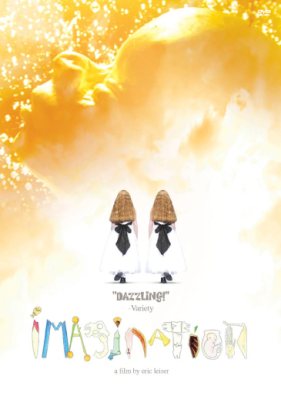
I'll admit it, I didn't come to this film with high hopes. I had seen Netflix reviewers trash it again and again, but I hoped that it would at least be 'original.' By the middle, when the talking fruits showed up, I was waiting for the one hour ten minutes to end. By the credits, I was wondering how such a horrific trainwreck ever came into existence. There's a vague possibility that this could have been a good, albeit strange, film. What went wrong? As it turns out, almost everything.

The plot (if you can call it that) follows two prepubescent girls named Anna and Sarah through their joined imaginary realities. Their parents are struggling- Sarah is nearly blind, and Anna has Asperger's Syndrome, a form of autism. As their psychiatrist attempts to understand their increasingly bizarre fantasies, we watch dream-like sequences done through stop-motion animation and special effects. When tragedy strikes, the girls retreat further into their imaginations, causing the psychiatrist to wonder what the visions mean.

That's pretty much the sum of the story, avoiding spoilers. It actually was an interesting idea, visualizing two introverted girls' secret world. The result, however, is horrendous.

First of all the acting is pathetic- hard to watch. As you watch the actor's pitiable attempts to be 'emotional,' you wonder how they could have possibly set themselves up for this kind of humiliation. It feels like the director went out to a local park, watched people for a while, and chose a few, asking them to be in a movie. They agreed, despite their complete lack of dramatic skills. The two girl's performances are understandable- they're still young, after all. However, watching the adults, especially the psychiatrist, desperately trying to play a role, leaves you shaking your head in horror.

The other problem with "Imagination" is that Anna's 'Asperger's Syndrome' and Sarah's blindness are pointless; more or less just there to rationalize bizarre dream sequences. What may of helped this film is to explain why the girls 'live in a world all their own.' Anna, we are told again and again, 'can't socialize,' but we never see her interact with practically anyone in the film. It would have been interesting- more interesting, perhaps, than the weird trip scenes, to try to explain Sarah and Anna's need to go into their own realities. Ben X did this efficiently- We understood why the main character, Ben, became obsessed with the virtual world and tuned out of real life. "Imagination," however, is obviously a miserable attempt to play with hallucinogenic effects and claymation, without a glimmer of character development or logic to make sense of it.

There is one good quality, however. Even though the filmmakers got so many other things wrong, their skills at claymation are apparent. One scene, in particular, is darkly creative and weird, in a good way. In this case, the bizarre imagery actually attracted my attention. It makes you kind of wish they would kick out the actors and let the clay figures take center stage.

All in all, I wouldn't recommend this movie to practically anyone, unless they are especially fond of weird for weird's sake. Do not watch this looking for a realistic or informative view of Asperger's- you won't find it here. If you want something unusual, watch "The Fall"- in fact watch practically anything else. Just stay far away from this bizarre, pointless mess of a movie. (Rated NR) *


Trailer Not Available

Thursday, March 12, 2009

Ben X


"Ben X," Belgian director Nic Balthazar's film debut, is an ambitious drama exploring the autistic mind and how far harassment can go before the victim loses control. At the beginning, we are introduced to Ben ( superbly played by Greg Timmermans,) a teenage boy with Asperger's Syndrome who lives with his well-meaning mother and younger brother. Ben spends all his free time playing Archlord, a fantasy role-playing game where he becomes Ben X and plays alongside Scarlitte, a teenage girl who is impressed by his gaming skills. The game gives him a sense of purpose in a world that becomes increasingly out of control.

Ben's life at school, quite simply, is hell. Relentlessly tormented by two repugnant teenage boys, his teacher's try to help him but are ineffectual to do so. The situation worsens when an embarrassing prank preponderated on him is videotaped and posted all over the internet. Feeling that he has no where to turn to, he hides what happened from his family and teachers and becomes increasingly disturbed and suicidal.

Finally, close to breaking point, Ben decides to meet with Scarlitte, who is interested in visiting him in real life. Together with Scarlitte, his divorced father, and his desperate mother, he comes up with a bizarre plan to get back at his tormenters.

I waited a long time for this movie, and as it generally is in this case, was disappointed. Which isn't to say that "Ben X" is a bad film. On the contrary, it has many good qualities. The main thing that struck me was that this is one of the first times a character on the autistic spectrum takes center stage, and is treated as a person, not a plot device. Often, the character with autism is used to evoke feelings from the other people in the movie, or to teach them what is really important in life. This film, without avoiding the family's perception of the situation, concentrates on Ben and his reactions to what's happening around him.

Secondly, the acting in "Ben X" is top-notch, especially from Greg Timmermans and Marijke Pinoy, as Ben's mother. Greg Timmermans has excellent facial expressions and mannerisms, and in his and the directors hands the main character becomes a real person.

Many scenes and situations in "Ben X," however, are very melodramatic and over-the-top, but the ending is it's greatest weakness. Alternately bizarre and unrealistic, it detracts from an otherwise good movie. The director seems to think that neatly tying things up is more important than realism, and it shows. The film builds up a great deal of suspense and a foreboding that something terrible will happen, but seems to wimp out toward the end. I don't enjoy depressing endings, but I felt that the conclusion wasn't believable at all.

I am bound to cut this film some slack, because there are so few movies about high-functioning autism and because I waited a long time to watch it. Although I think it was ultimately disappointing, it also did many things right and tried to do what most directors haven't done effectively before. (Rated NR) ***1/2

Recommendation- For another subdued portrait of a teenage boy in crisis, watch Gus van Sant's Paranoid Park


Wednesday, March 4, 2009

The Fall


Visually stunning film starts out in 1920's Los Angeles, where a 5-year-old immigrant named Alexandria stays at a hospital after falling from an orange tree and breaking her arm. As she begins to recover and explores the wards, she comes across a young man named Roy (Lee Pace,) a Hollywood stuntman who was injured trying to impress his girlfriend. Grieving over her leaving him and his troubles with his movie corporation, he entertains Alexandria with a vivid story about a group of five heroes bent on revenge against the evil Judge Odious.

We are taken to an unspecified time and place, where the group tries to escape from an island the judge has marooned them on. They are all after him for different reasons, but join up in order to defeat him. The main characters are

(1) The Masked Bandit, the hero, who is trying to save his twin brother from Judge Odious and his men. In Alexandria's imagination he resembles Roy.

(2) Charles Darwin (Leo Bill), a scientist, is obviously the intellectual of the group, and he is after Judge Odious because he killed a butterfly. He does, however, seem to be a few cards short of a full deck, as he discusses scientific theorems with his beloved monkey, Wallace.

(3) Oda Benga (Marcus Wesley) is a former slave whose brother died of heat exhaustion in the fields. He is physically fit but not educated, due to the fact that he's worked all his life.

There are two other heroes, Luigi, an Italian explosives expert, and an unnamed indian. One of the interesting things about this movie is that the director never loses sight of the idea that the adventure Roy tells Alexandria is a story, and so it is flexible in the hands of the teller and the listener. Roy's 'indian' is apparently Native American, being that he uses words like 'squaw' and 'wigwam.' Alexandria, who doesn't know the terms, pictures him as a native from India, complete with bright clothes and a full beard. Although it isn't accurate, that is how Alexandria perceives the character, so that is how we see him.

As the story reaches it's climax, it becomes clear to the viewer that Roy's intentions are not as clear as he wants Alexandria to believe. In fact, the morphine he continually requests that she steals is not to 'help him sleep,' but rather a method of suicide, and he is telling the story to convince Alexandria to help him kill himself. Also, Roy's story begins to bear resemblance to his own life.

This movie is almost worth seeing entirely for the brilliant cinematography, which was filmed over a period of 4 years in 18 different countries. If skillful camerawork isn't your thing though, there's still plenty to recommend it. It's consistently intriguing, alternating between real life and the fantasy reality that Roy has created. Even though some reviewers complain that there was little empathy for the characters, others (myself included) were genuinely involved with the story and disappointed when- oh, never mind. Watch it yourself. Although character development isn't the movie's main priority, it generates enough sympathy for the characters (both real and imagined) to keep you interested.

I do however have a few quibbles- well namely, one. Halfway through the movie, they include short sequence that is so out of context with the rest of the story that I scratched my head over how it got there. It felt like it was shoved in to add some flavor to the film. I'm not sure why this was necessary, as there's plenty of plot line here to use. As it is, the clip feels like an early draft of a surreal short film somebody forgot to remove from the major movie.

"The Fall," all in all, is a very unique and rewarding film experience. It's different from everything I've ever seen, and that's part of why I like it. I recommend it to anyone who wants to get away from standard Hollywood fare. It certainly isn't without it's flaws, but you have to admire the directors fierce originality (Rated R.)


Friday, February 27, 2009

The Secret Life of Bees


Set in the 1960s, "The Secret Life of Bees" is a fairly faithful adaptation of Sue Monk Kidd's novel of the same name. Growing up motherless and dominated by a harsh, cold father, 13-year-old Lily Owens (Dakota Fanning) has no one who cares for her except her black nanny, Rosaleen (Jennifer Hudson.) When Rosaleen pours snuff juice on the shoes of a couple of racists who harass her, she is beaten and hospitalized, and Lily springs her out. They head for Tiberon, South Carolina, a town written on on of Lily's few mother's possessions. They hitch a ride there, and go to a house occupied by the Boatwrights, a group of beekeeping sisters Lily has reason to believe knew her mother.

Lily concocts a story about her father dying, afraid that the Boatwrights will contact him if she tells the truth. The eldest of the sisters, August (Queen Latifah,) welcomes the two with open arms into her and her sister's home. Lily does not ask April right away about her mother, but spends some time getting acquainted with her new surroundings. The Boatwrights are an eccentric trio.

May (Sophie Okonedo) the most unstable sister, is consumed in everyone else's suffering. She spends hours by her 'wailing wall,' writing things that depress her onto slides of paper and sticking them in between the stones. June (Alicia Keys,) who is the least accepting of Lily's arrival, refuses to marry her love interest Neil, but cannot seem to leave him either.

April teaches Lily the tricks of beekeeping, and she and Rosaleen fit comfortably in their new life. Lily even becomes secretly involved with Zach, a black boy her age. Slowly, and with the Boatwright's help, she begins to heal. One fateful night, however, her father tracks her down, and she must fight for everything she fought so hard to obtain.

Having read the book on which this film is based on, I will most likely compare the two. I try not to be a the-novel-was-so-much-better critic, as books and movies are vastly different. The film, actually, is very true to the original. I do, however, have some complaints to point out. First of all, it is not 'racist,' as Owen Gleiberman claimed, but August seems a bit unrealistically understanding. She is the least developed of the sisters. Although Queen Latifah does a good job portraying her, August is so incredibly kind and nurturing, and seems to have little thought for her interests, that she seems one-dimensional. I can, however, keep a suspension of disbelief, being that by caring for a mentally ill sister she could have learned to put her own feelings aside.

The other aspect I disliked actually compares it to the book, which I tried not to do. Lily's conversation with her father at the end of the movie has been changed, in a and in a way that I feel undermines much of the effectiveness. I will not spoil it for you, but I thought the scene in the book was one of the most moving, and during the movie I found myself wishing it had not been trifled with.

That aside, for the most part I liked it. The acting was very good and the screenplay remained true to the characters. I would recommend it to anyone who enjoyed the novel. Although some aspects annoyed me, all in all I felt it was a fine film. (Rated PG-13)


Tuesday, February 17, 2009

Le Fabuleux Destin d'Amélie Poulain (Amelie)


Don't be put off by the picture of the creepy-looking girl in pale makeup on the cover of "Amelie," or get the impression that it's a bizarre horror movie. It's actually a quirky French comedy/drama, with traces of magical realism to add to the tone.

It starts with the a random chain of events one of which results in the birth of a little girl named Amelie. She grows up lonely, living in a household with a cold father and neurotic mother. I will not list all the misfortunes that befall her, but suffice to say that she has enough heartbreak and misery to last her a lifetime. In the midst of her problems, she retreats into her imagination, and grows up into a good-hearted but shy young woman (played by Audrey Tatou) who has difficulty with social relationships, let alone a love life.

When she moves out of her father's house (her mother is dead,) she gets a small apartment and a job at a small cafe, surrounded by local eccentrics. Among these are a mentally unstable, bitter man stalking his ex-girlfriend, a hypochondriac who spends her time complaining about her ailments, and a mean-tempered grocer who verbally abuses and publicly humiliates his quiet employee, among others. There is one man, who spends his time in a train stations collecting photographs from under a photo booth, who Amelie has known since childhood and is secretly enamored with, but the doesn't get up the courage to talk to him.

The story really begins when Amelie discovers a small tin box hidden in her bathroom wall. Upon further inspection, she finds out in it is a collection of small items hidden by a little boy many years ago. That night, she decides that she will seek out the owner of the box, and if he is touched, she'll become a regular do-gooder. She proceeds to ask her neighbors if they know who the items belong to. They;don't, but from the stories they tell her; she realizes that she isn't the only lonely person around.

When she finally meets the owner of the box, it not only moves him greatly, it also makes him feel compelled to seek out his estranged daughter before he dies. Keeping with her promise, Amelie begins a journey to help the people around her using any means possible. Aiding her neighbors to find love and happiness, she also follows her own type of justice, punishing the nasty grocer with practical jokes. As the lives of others begin to improve, she comes to realize there is one person she isn't helping achieve her dreams- herself.

This film keeps you interested from the beginning, starting with a unique narration a Amelie's young life by an omnipotent narrator. It manages to get you involved with Amelie and her troubles. Although the narrator's voice disappears after a while, the interest in the story and characters prevails.

Unfortunately, it gets a bit confusing around the middle, and it took me three tries to get all the way through it. However, I continued to try to finish the movie, which is saying something. After it was done, I was pleased that I saw the whole thing, and I would recommend it to someone, especially one with a interest in foreign cinema. This is one of the best efforts to capture a character through filmmaking I have seen, and although it is along trip, it's well worth it. (Rated R)


Trailer Not Available

Sunday, February 15, 2009

A Good As It Gets


Melvin Udall (Jack Nicholson) is the kind of man most people wouldn't want to meet. A bigoted, obnoxious writer with Obsessive-Compulsive Disorder, he spends his life avoiding cracks in the sidewalk and verbally abusing everybody around him, including his soft-spoken gay neighbor, Simon (Greg Kinnear.) The only person he will tolerate is Carol (Helen Hunt,) a stressed-out waitress struggling to support a chronically sick son. Carol, unsurprisingly, despises Melvin.

One day, Simon is robbed and badly beaten by a couple of thugs, and is unable to care for Verdell, his beloved dog. His partner, Frank (Cuba Gooding Jr.) decides to coerce Melvin into caring for the animal, as payment for his relentless bullying of the couple. Simon is understandably worried for Verdell's safety (Melvin once threw him down a garbage disposal,) but goes along with the plan. Luckily, Frank is the only person who really intimidates Melvin, and Verdell remains in one piece.

As the film progresses, Melvin begins to become a better person. At first for selfish reasons, he starts helping Carol and Simon, but eventually he becomes less self-centered and cares somewhat for others. He even forms an attachment for Verdell, Simon's ugly-but-almost-cute dog, who has an almost uncanny resemblance to an ewok.

The problem is, I'm making this movie sound like a tacky tearjerker, and it's actually quite good. This isn't the kind of epiphany story where Melvin suddenly learns to love humanity and turns from horrible jerk to lovely person (a la' "Rain Man.") Nor is it a testament to the Christian faith, like the totally forgettable "The Ultimate Gift." It is a nicely constructed story that provides no easy answers, no escape routes to morality. Also, some of the lines, especially Melvin's ("People who speak in metaphors ought to shampoo my crotch") are very funny and great to quote.

This is a very good movie, despite it's overlength (running at 139 minutes.) For you movie buffs, Jack Nicholson and Helen Hunt won best actor and actress at the 1997 Academy Awards.


Tuesday, February 10, 2009

The Savages


Wendy and Jon Savage grew up together, and both suffered abuse and neglect at the hands of their father, Lenny; but they're not exactly what you'd call close. Both are wrapped up in their own lives- Wendy (Laura Linney) is aspiring to publish her semi-autobiographical play, and is carrying on a dysfunctional relationship with a married man. Jon (Philip Seymour Hoffman,) on the other hand, is working as an English professor and is coping with his girlfriend's impending move to Poland, her home country. They are forced to come together, however, when they are called by Lenny's girlfriend's parents. Not only has the elderly woman died, Lenny also has senile dementia. This was discovered when his caretaker found him writing an obscenity in his own excrement.

Wendy and Jon are told they have to decide on a nursing home to put Lenny in. Wendy hopes to find a home where her father can be more independent, but Jon thinks that it's hopeless to try and put a senile man in a 'rehabilitation center.' This film records the siblings attempt to come to terms with both their dad's illness and their own relationship.

This is a movie I didn't like much until the second time I watched it. It's very slow, and neither of the main characters are totally likable. During the first viewing, I was bored by it and found the leisurely pace exasperating. The second time, however, I thought it was quite interesting and thought the acting was excellent. I didn't think the humorous parts very funny, though. I suppose they would appeal more to older people.

I thought this was a good film, although it was sad and moved slowly. You could sympathize with the main characters' father, Lenny, even though you certainly didn't want him as a dad. I wished I could have learned more about Jon and Wendy's lives, but the information they provided was eloquently placed and sufficient. I recommend this to the kind of people who like serious films that take their time. (Rated R)